Exploring the Need for Fast E-commerce: A UX Research Study
Mar 12, 2025
Project background
The rise of fast e-commerce has led to an important question: Do we really need it? Fast delivery for things like groceries, medicine, and food is helpful, but does it make sense to get things like electronics — for example, a PS5 — delivered in just 10 minutes? Buying electronics used to be exciting because people looked forward to receiving them after waiting a while. But with instant delivery, that excitement might go away, since you can get items right away.
Some people might like the idea of getting anything in under 10 minutes, but it could be a one-time thing, not something they need every day. It's also interesting to ask why big platforms like Amazon and Flipkart haven’t fully adopted fast delivery, especially when smaller apps like Blinkit, Zepto, and Instamart are doing well.
This research will look into whether fast e-commerce can grow in India, how people feel about fast delivery, and if getting things in 10 minutes really offers long-term value beyond essentials.
Research Question
Do Indian consumers need fast e-commerce delivery for non-essential items (e.g., electronics)?
How does fast e-commerce affect the excitement and perceived value of purchasing high-ticket items, like electronics?
Why have larger e-commerce platforms, like Amazon and Flipkart, been slow to adopt fast e-commerce, despite its growing success in the market?
Research Goals
To understand consumer demand for fast e-commerce in India, particularly for non-essential goods.
To investigate how quick delivery impacts the shopping experience for high-value items and whether it diminishes the excitement of the purchase.
To identify potential barriers and limitations of fast e-commerce, including consumer attitudes and market readiness.
To assess whether smaller apps like Blinkit, Zepto, and Instamart are sustainable models or if they represent a passing trend.
Methodologies
Qualitative Research:
Through secondary research and existing case studies, we will explore the perceptions and behaviors of Indian consumers regarding fast e-commerce, especially for non-essential items like electronics (e.g., a PS5 delivered in 10 minutes). By analyzing consumer feedback, reviews, and market trends, we aim to understand how such rapid delivery models influence their shopping experience and excitement. This will help us understand if such rapid delivery models impact excitement or consumer satisfaction.
The articles on consumer behavior and how fast delivery is changing shopping habits highlight that the thrill of purchasing high-value items may diminish with instant gratification -(source: Supply Chain Dive).
Competitive Analysis:
A detailed analysis of the growth of quick e-commerce platforms like Blinkit, Zepto, and Instamart has been conducted. These platforms are compared to major players like Amazon and Flipkart, who have been slower to embrace fast delivery.
Articles such as those from Fortune India and India Briefing highlight the success of smaller platforms and examine why larger e-commerce giants have not fully committed to fast delivery
“Quick commerce is already contributing $1 billion in GMV and setting benchmarks for speed,” -(source: Fortune India).
Market and Trend Analysis:
Market trends and consumer behavior related to fast e-commerce were analyzed using data from several industry reports, including those from India Briefing and Fortune India. These sources provide valuable insights into the growth of the quick commerce market in India, as well as consumer expectations regarding fast delivery services. For instance, India Briefing highlights the increasing demand for quick commerce services in urban areas, while Fortune India discusses the success and challenges faced by players like Blinkitand Zepto in the fast e-commerce space.
Research Questions
Example Questions:
How often do you purchase electronics online?
How important is delivery speed when buying non-essential items (like a PS5 or a new phone)?
If a retailer offered 10-minute delivery, would it influence your decision to purchase? Why or why not?
Do you find the idea of getting an expensive product delivered so quickly exciting, or does it take away from the experience?
Would you pay extra for faster delivery of electronics?
What are the key factors that would make you choose fast e-commerce over standard delivery services?
What are your thoughts on apps like
Blinkit,Zepto, andInstamartoffering rapid delivery?Do you think this model will last?Why do you think bigger platforms like Amazon or Flipkart haven’t fully adopted fast e-commerce?
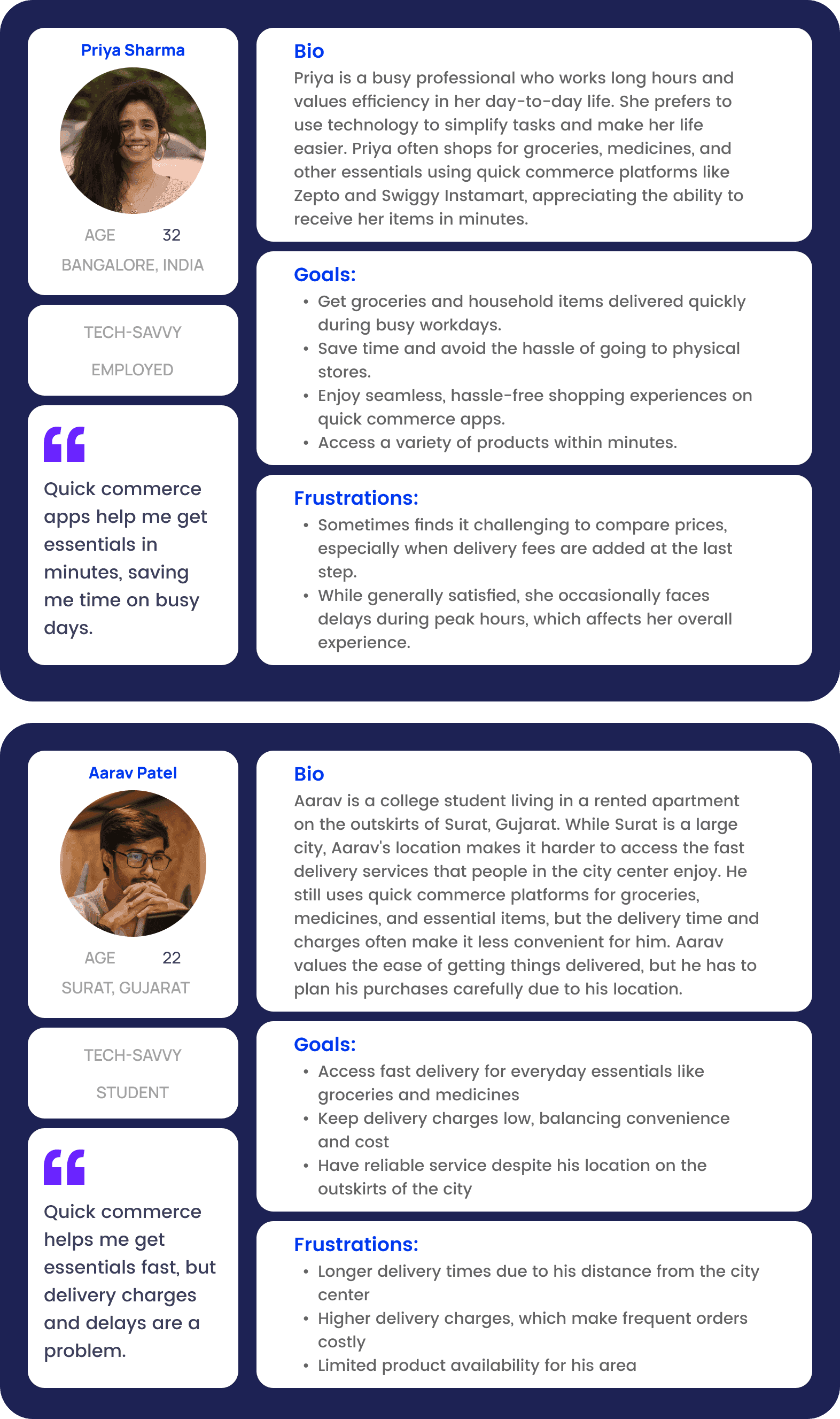
User Personas
Leading quick commerce companies in India
Zepto
Founded in 2021, Zepto has rapidly gained traction by offering grocery and essential delivery in as little as 8-10 minutes. Its network of over 100 micro-warehouses enables the company to fulfill 2,500 orders daily in cities like Mumbai, Delhi, Bangalore, and Chennai. Zepto also experiments with nominal platform fees and higher charges during peak times to enhance profitability.
Blinkit
Previously known as Grofers, Blinkit is a pioneer in the quick commerce space. It operates in 14 cities and boasts a market share of 46 percent, the highest among its competitors. With over 250 micro-warehouses and partnerships with 14,000 delivery agents, Blinkit ensures seamless operations and quick turnarounds, delivering essentials in 10-20 minutes.
Swiggy Instamart
Launched in 2020, Swiggy Instamart leverages Swiggy’s existing delivery infrastructure to deliver groceries within 45 minutes across 18 cities. By collaborating with dark stores and utilizing eco-friendly delivery methods like e-bikes, it has become a formidable player with a 27 percent market share.-Source (India Briefing)
How Quick Commerce Got This Big?
Changing Consumer Expectations
Consumers now expect fast and personalized services, thanks to the convenience of smartphones. Quick commerce meets this need by offering super-fast delivery, making it a popular choice for busy shoppers.-Source (India Briefing)
Impact of COVID-19
The COVID-19 pandemic boosted quick commerce because people needed contactless deliveries. Lockdowns pushed more consumers to shop online, and quick commerce was ready to provide fast, safe deliveries.-Source (India Briefing)
Rise of Technology and Trust in Online Shopping
In the past, many people were hesitant to trust online e-commerce platforms and preferred shopping in retail stores. However, with the rise of affordable internet, easy payment options like UPI, and well-designed apps, consumers have gained confidence in online shopping. Quick commerce leverages these technological advancements to meet the growing demand for fast deliveries.
Findings/Insights
Consumer Preference for Fast Delivery of Essentials
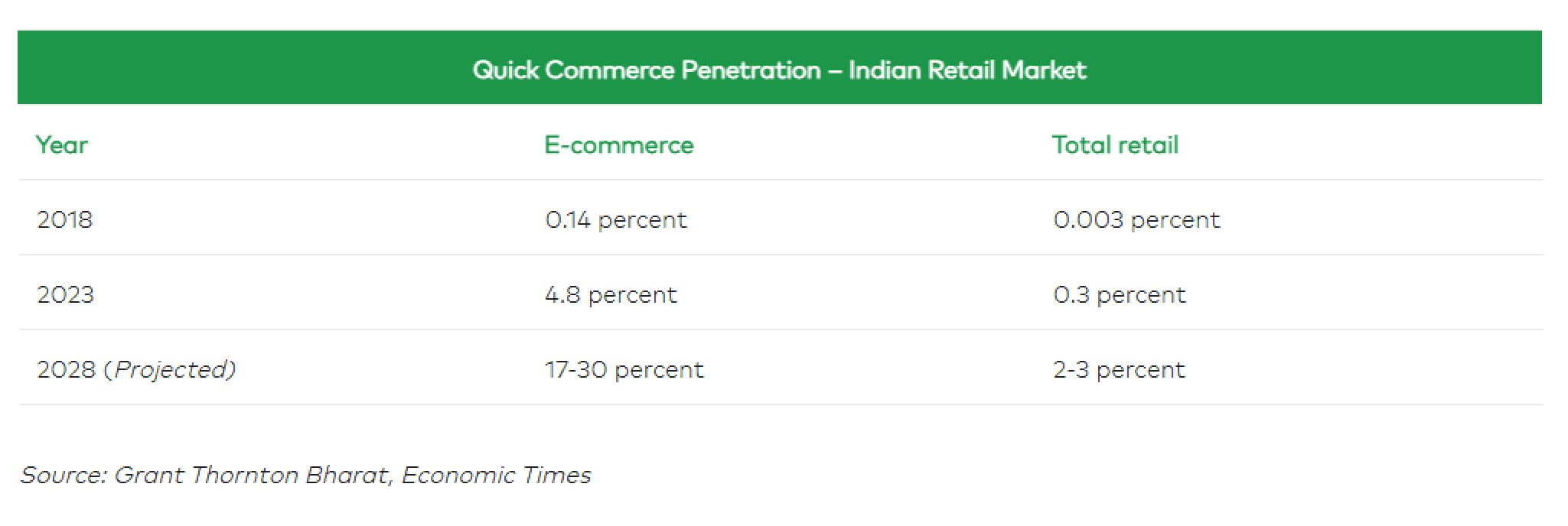
Through research, it’s clear that consumers prioritize fast delivery for essential items such as groceries, medicines, and daily necessities. The demand for quick commerce services is driven largely by the need for convenience, especially in urban areas. Many consumers find the quick commerce a great idea for them as its save them time.
Impact on Local and Retail Shops
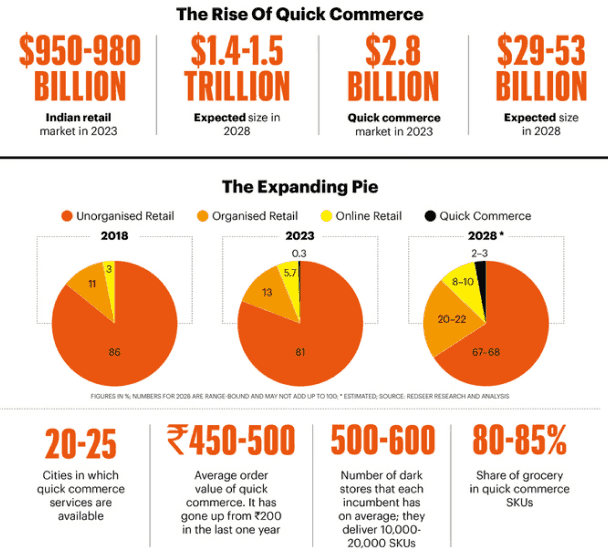
As per this data by Fortune India we can see that more than 50% of the market is still unorganized retails and the share of Quick Commerce in the market is mostly about grocery so we can say that for electronics the quick commerce is still a new start and people will still prefer the electronic items to be bought in a store.
User Experience and Interface Design in Quick Commerce Apps
UX Practices
Quick commerce apps have revolutionized the shopping experience with their ultra-fast delivery models, but their UX/UI design has not been without criticism. One of the common issues raised is the use of "dark UX" patterns, where design elements are intentionally crafted to manipulate users into making unintended decisions. A notable example can be seen in Swiggy Instamart, where users have reported items like "free tomatoes" being added to their carts without consent, making it difficult for customers to remove them easily. This kind of design has raised concerns over transparency and user trust, as it can lead to negative perceptions about the platform’s intentions.
Strategic product placement
Just like the supermarket this strategy also works in the eCommerce market where user will most probably buy more than the item they need. One such tactic is strategic product placement, where items are positioned to attract attention and stimulate additional purchases. For example, placing complementary products together, such as pairing cookies near milk, encourages customers to add both to their carts.
Impulse buying
Impulse buying is a powerful retail strategy, especially in quick commerce apps and physical supermarkets. One of the most effective ways to stimulate impulse buying is by placing eye-catching displays and limited-time promotions near high-traffic areas, such as checkout counters in quick commerce apps they use banners, promotions, notification etc. These displays are designed to grab the consumer’s attention and spark the desire to purchase items that were not originally on their shopping list.
Conclusion
Quick commerce in India has seen significant growth in recent years, primarily driven by the increasing demand for fast deliveries of essential items like groceries, medicines, and daily necessities. In urban areas, where time is often a scarce resource, consumers are turning to quick commerce platforms to fulfill their immediate needs. The convenience of having groceries delivered within minutes, without leaving the comfort of their homes, has become a major attraction. This shift towards fast delivery for essentials reflects a broader trend in consumer behavior, where people value speed and convenience more than ever before.
However, this demand for rapid delivery is not as intense when it comes to high-ticket items such as electronics, luxury goods, or expensive gadgets. While products like smartphones, laptops, or gaming consoles are in high demand, consumers generally show more patience when purchasing these items. The excitement and careful consideration involved in buying electronics—often influenced by factors such as research, comparison, and budget constraints—reduces the need for ultra-fast delivery.
Refrences